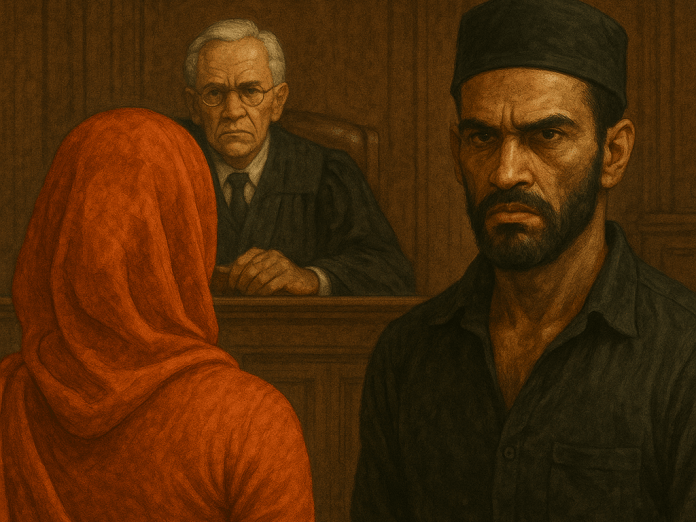
The Supreme Court will soon hear a bunch of petitions challenging the constitutional validity of anti-conversion laws enacted by several states, including Uttar Pradesh, Madhya Pradesh, Himachal Pradesh, Uttarakhand, Chhattisgarh, Gujarat, Haryana, Jharkhand and Karnataka.
The petitioners, who include controversial bodies such as Jamiat-Ulama and Teesta Setalvad’s NGO, have cited alleged harassment of Muslim men in ‘interfaith’ relationships under anti-conversion laws as their key argument to strike down the laws. These petitioners referred to the term ‘love jihad’, to which we come later in the report below, as “baseless rhetoric”.
We – the team behind Rashtra Jyoti and Sewa Nyaya Utthan Foundation – have intervened in the matter in a big way.
We are enabling 25 victims or kin of victims of forced conversions file counter petitions in the apex court to defend the laws. Besides, the team comprising Swati Goel Sharma, Sanjeev Newar and others had already filed an intervention petition in the Allahabad high court in 2022 when the law in UP was challenged.
The case documented below, of Kanta, is among the many real-life cases that we have placed before the courts to demonstrate the lived reality of deception, trapping and forced religious conversion.

#1: How Kanta met Imran
In January 2018, the two met on a local bus. He introduced himself as Rahul and said he knew her father as they were both in the same business of making khoya for supplying to sweet makers.
They hailed from neighbouring villages in western Uttar Pradesh’s Baghpat district.
“We got talking, exchanged numbers, and then entered into friendship and fell in love,” Kanta told this writer.
“He said his name was Rahul Malik. I had no reason to not believe him as his village, Sadikpur, is Jat-dominated and Malik is a common surname.”
Sadikpur is 20 kilometres from Kanta’s village, Fatehpur. At that time, she was living and working in Gurgaon near New Delhi and was visiting Baghpat.
#2: They eloped and married
Two months later, Kanta’s family, unaware of her love affair, fixed her marriage in their community. That’s when he told her he was Muslim and his name was not Rahul. He said he hid his real identity fearing she wouldn’t pursue him.
Kanta told this writer she indeed wouldn’t have pursued him had she known it earlier. But by the time she learnt the truth, she could not bring herself to break up with him.
Knowing she could not reveal her relationship to her family, she eloped with him on 26 March 2018, exactly a month before her arranged marriage was scheduled.
She recalls, “Imran would call me and ask me to run away with him, promising he would keep me happy. At times, he threatened to harm himself and my family if I didn’t. I decided that he loved me and would keep me happy.”
Talking to this writer in 2019, she said, “Nothing even remotely like this happened. I was instead tortured by him and his family”
#3: Nikah, then Hindu registration of marriage
As per Kanta, the couple went straight to New Delhi where a friend of Imran helped them get rented accommodation in Ghaziabad near Delhi.
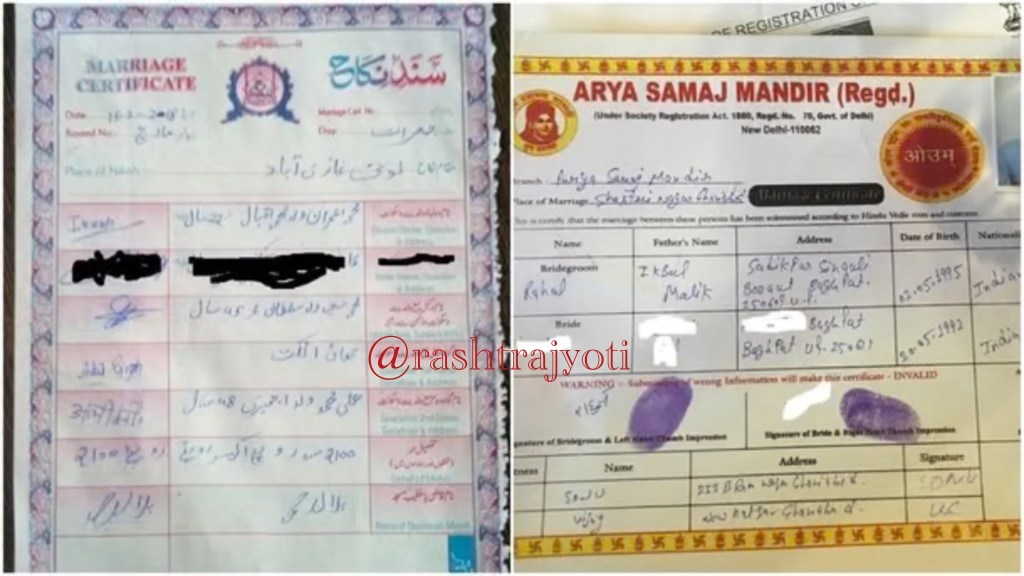
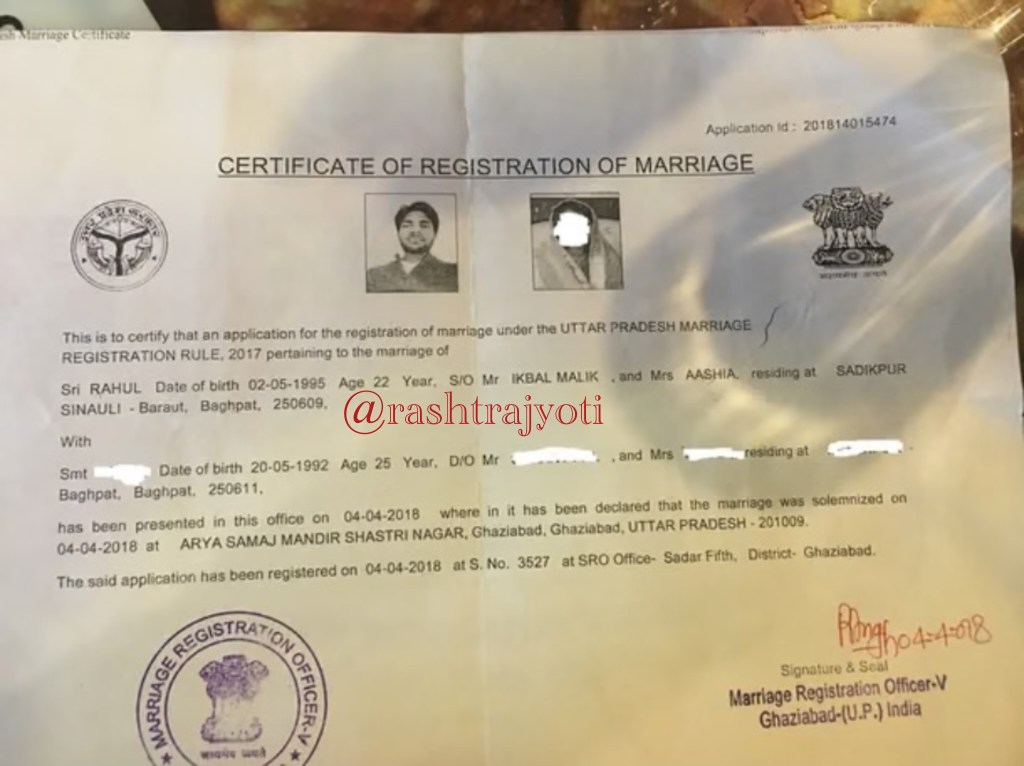
It was in Ghaziabad that the two got married. The couple first registered their marriage in a mosque and then in a Hindu Arya Samaj temple.
The nikahnama, dated 15 March, mentions Kanta’s name as Zoya.
The marriage certificate issued by the temple, dated 4 April, mentions Imran’s name as Rahul.
Kanta had no role in either of the paperwork other than signing them.
“It was all his idea. He first asked me to sign the nikahnama on 29 March. When I asked him why it had a date of two weeks earlier, Imran told me to ignore that detail. A week later, he again gave me another document to sign, this time from Arya Samaj,” she said.
She admitted she found it strange but never dug deeper into it. However, what irked her was that her marriage wasn’t solemnised as per any religious ritual. “I never saw the Arya Samaj temple where we supposedly got married. There were no pheras or mangalsutra ceremony. There was only a document I signed on sitting at home.”
She recalled, “Imran told me the Arya Samaj document was for the government. The nikahnama was Imran’s proof to his God that he had brought me into the Muslim fold.”
“He told me I am Muslim. I told him no, I was not. He left it at that.”
Meanwhile, Kanta’s father had filed an FIR alleging she had been kidnapped. One day, Imran brought her yet another document to sign. It was an affidavit in the name of Kanta that she had married ‘Rahul’ with her own will. In an order dated 11 April, a bench of Allahabad High Court said there was no case as Kanta, aged 27, was a major.
#4: Marriage turned out to be a sham; she ran
As she learnt in the weeks to come, Imran never used his Hindu identity anywhere and insisted on always calling her Zoya.
He despised her following any Hindu ritual. “He didn’t even allow me to keep the murtis of my gods,” she said. “He forced me to do many things despite my objections, such as cooking and eating meat.”
Throughout her stay at Imran’s house, she was kept away from the public eye. “If their relatives came, I would be asked not to step out of the room. They would hide the fact even from neighbours that I was a daughter-in-law and was living there.”
Kanta ran away from Imran’s house on 22 November 2018. On her way, she called her father to pick her up and take her home.
Kanta’s father told this writer he had considered her dead after her court affidavit. But such is the heart of a parent that when she called up eight months later, he desperately wanted to see her and bring her back, he said.
“She was in bad shape when I saw her,” he said. “No father should see his daughter like that.”
On 5 December, Kanta filed an FIR against Imran and his family at Singhaoli Ahir police station of Baghpat (number 504/2018).
Her statement recorded in the FIR said that after marriage, Imran’s family insulted her by constantly calling her ‘chamaari’ and abused her for not bringing any dowry.
Imran’s elder brother, Shahid, also forcibly made physical relations with her. When she told her husband about it, he said this was exactly why he had brought a ‘chamaari’ like her into his house.
Based on the statement, the police booked ‘Imran alias Rahul’, his mother Ashia, his father Iqbal and his brothers Shahid and Irfan under IPC Sections 498-A (harassment over dowry), 323 (causing hurt), 504 (intentional insult), 376 (rape) and 506, and under sections of the Scheduled Castes Prevention of Atrocities Act.
No arrests were made. The family managed to get a stay order on the arrests from Allahabad High Court.
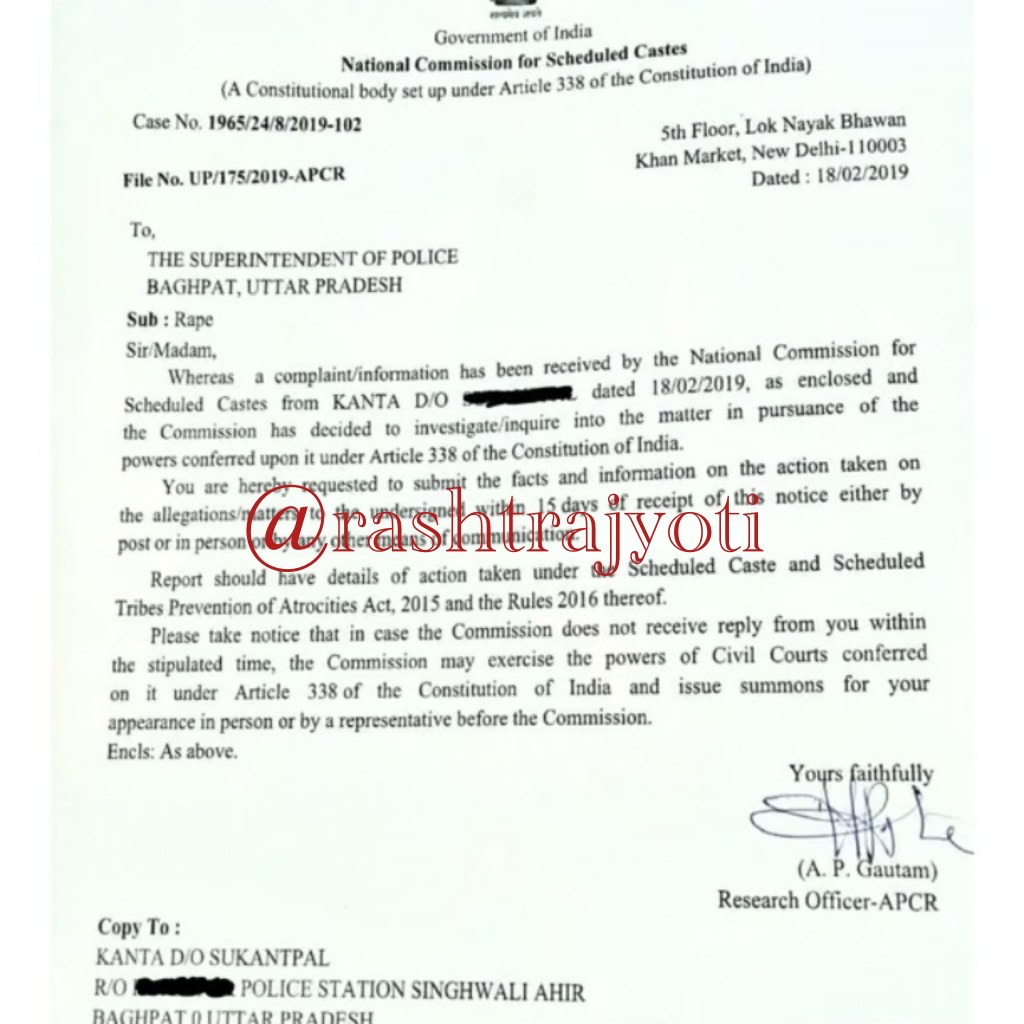
In February 2019, she approached National Commission for Scheduled Castes (NCSC) in New Delhi to request the commission to direct the Baghpat police to take action in the FIR filed by her.
On 18 February 2019, the commission issued a notice to the Baghpat superintendent of police to give an action-taken report in 15 days. However, no arrests have ever been made in the case. The police replied to the Commission that they could not do so since the Allahabad high court had ordered a stay on the case.

#5: She got divorce, court called Imran a fraud
In the same month of 2019, Kanta filed for divorce under Section 12 of the Hindu Marriage Act.
Imran, in turn, sent her a legal notice under Section 9 (restitution of conjugal rights in the Hindu Marriage Act).
Imran told the court that Kanta did not leave his house and, instead, it was her family that forcibly took her away and eventually brainwashed her against him. He said the divorce plea should be dismissed.
Kanta told the court that she left his house on her own, and that after she left, Imran did not make any phone call or efforts to bring her back.
The court observed that while Kanta’s statements appeared true, Imran’s version did not.
The court said, “[Kanta’s] statements do not appear to be contradictory or untrue. Her statement appears to be true and believable.”
The court observed:
- that Imran changed his name to Rahul for the marriage paperwork, only to mislead and cheat the woman
- that while he wrote his name as Rahul in the marriage registration form, he has not been able to produce any other document that supports proof of change of his name or religion.
- that even in a document dated 22 July 2019, he had given his name as Imran Malik.
- that his entire family observed the Muslim faith and read namaz
- that Imran himself admitted that in his heart, he continues to worship Allah
- that Imran obtained Kanta’s consent for marriage by fraud
“It can be concluded from [Imran’s] statements that he never accepted Hinduism. He wrote his name as Rahul in the marriage form only to mislead the woman. He was born Muslim and continues to be Muslim,” the court observed (as translated from Hindi).
In the verdict on 31 July 2020, the bench of Awadh Bihari Singh, Principal Judge, Family Court, Baghpat, said that since Imran is a practising Muslim, the marriage registered under the Hindu Marriage Act was null and void as the Act required both partners to be Hindus.

#6: Imran faced no consequences
The same year the divorce came through, in the presence of the police, both sides agreed to enter into a ‘compromise’.
It was decided that Imran would not harass Kanta, and Kanta would not pursue the criminal case.
Kanta told this writer she remarried in 2021, in her Hindu community.
The need for anti-forced conversion laws
The divorce came about four months before the Uttar Pradesh government brought about the UP Prohibition of Unlawful Religious Conversion Ordinance to punish religious conversions through force, coercion, allurement or fraudulent means.
Now an Act, it has been made stricter over the years, with penalties ranging from imprisonment of 3 to 10 years for illegal conversion, up to 14 years for mass conversions, and 20 years to life imprisonment for conversions involving threats, force, marriage inducement, or human trafficking.
Kanta’s case has all the features of a case of ‘love jihad’ — a term used by Christian, Hindu, Jain, Sikh and Buddhist groups for the pattern of cases where Muslim men lure non-Muslim women into romantic relationships with a goal of converting them to Islam and starting a Muslim lineage.
Islamist groups dismiss the term ‘love jihad’ as Islamophobic and call it ‘Hindutva propaganda’.
Use of fraud — such as faking religious identity when introducing oneself to the woman or making false promises that the woman would not have to change her name or religion after marriage — has been found to be a recurrent feature in ‘love jihad’ cases.
The Ordinance was a result of protests against ‘love jihad’ by various communities, besides anger over fraudulent conversions by Christian groups.
In the first month of its enforcement, 14 cases were filed — 13 involved forced conversion of Hindu women by Muslim men while one involved alleged forced conversion to Christianity. An analysis of these cases revealed that in seven out of nine of these cases where the woman had recorded her statement in front of the magistrate, she supported the allegations made in the FIR.
How to support our legal fight
To contribute to Sewa Nyaya Utthan Foundation, click here.