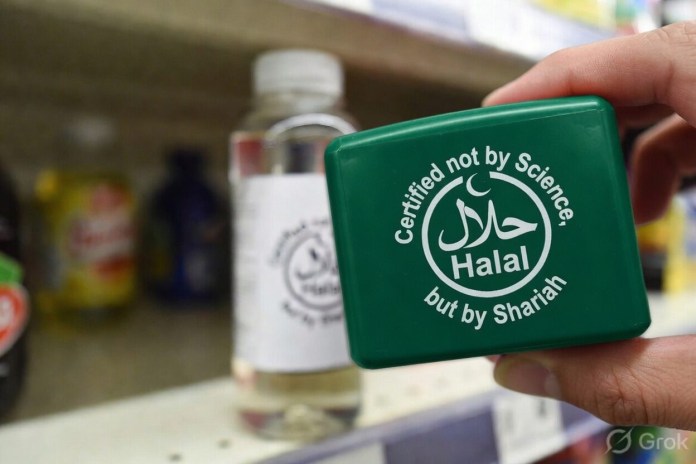
Halal is not a food preference. It is not about hygiene. It is not a personal choice. It is a religious compliance mechanism rooted in Shariah law.
To think of Halal as a simple dietary standard is delusion. Halal certification is a theocratic monopoly disguised as consumer safety. It enforces Islamic theology into secular economies, establishes Muslim-exclusive gatekeeping, and enforces silent religious domination over everything from food to finance.
This is not about meat. This is about control. About who gets to define what is pure. Who gets to approve what you eat. Who gets to monopolize certification. And who gets to profit while others kneel.
Halal Is Theological, Not Hygienic
The Quran (5:3) explicitly declares that meat is only permissible if slaughtered in the name of Allah.
Hadith literature – Sahih Muslim 1966a and Sahih Bukhari 2057 – makes it compulsory to invoke Allah’s name during slaughter. Meat not slaughtered in this manner is not just unlawful – it is spiritually polluted.


Even for vegetarian or non-meat items, Islamic authorities insist on certification. Why?
Because Halal is not about ingredients. It is about who has the religious right to approve. The theology demands that even harmless substances must be passed through Islamic filters.
The Logic of Ritual Sanctification: Nafth, Tafl, and Spiritual Control
Islamic traditions speak of Nafth – ritual blowing – and Tafl – spitting after reciting verses – as spiritual acts of blessing, healing, and protection.
Prophet would blow (Nafth) after reciting Surahs to protect himself.
Sahih Bukhari 5748
Nafth was used to transmit protection from harm.
Sahih Muslim 2192a
Prophet instructed believers to spit thrice after nightmares.
Sahih Muslim 2262a
These acts are symbolic transfers of barakah (spiritual blessing).
They are central to how Islamic theology understands sanctification.
They are used to bless food, water, weapons, people, even animals.
These are not optional. They are not folk customs. They are scripturally sanctioned rituals embedded into the Islamic imagination.
Therefore, to assume that they are excluded from Halal certification – the most central act of religious economy – is to be strategically naive. Even if not publicly visible, such rituals or their symbolic equivalents are likely retained.
Why should I consume anything or pay for anything where even a single saliva droplet is mandatory?
Halal Certification Is a Control Grid, Not a Single Ritual
Halal is not a single act. It is a layered civilizational structure. Modern Islamic jurisprudence has extended Halal requirements to:
- Food (veg and non-veg)
- Grains and supply chains
- Medicines, cosmetics
- Clothing (threads, dyes, stitching)
- Real estate and finance (buildings, contracts, loans)
- Infrastructure – even buildings and housing complexes
In countries like Malaysia, buildings themselves are Halal certified. This includes inspection of kitchens, prayer zones, non-use of prohibited substances, and banning of ‘haram’ enterprises on premises. Halal real estate is marketed as spiritually safe, ritually pure, and compliant with Islamic values. This is theological architecture imposed through commercial real estate.
India is also witnessing such Halal real estate.
Thus, Halal is not about consumption. It is about territory. It is about spiritual control of matter and space.
Examples of Concern from India
Slaughterhouse monopoly: In several Indian states, municipal slaughterhouses are Halal-only, forcing even Hindu meat sellers to comply or be excluded from the market.
Job exclusion: Non-Muslims are barred from roles in Halal slaughter or certification, creating faith-based economic discrimination.
Halal stamp on vegetarian products: Even products like biscuits, namkeens, and water bottles are Halal certified in India, often without consumer awareness. Many major Indian food brands quietly obtain Halal certification to cater to export markets, but this creates silent Shariah filtration on all consumers.
Temple prasadam facilities and caterers: Some contractors serving Hindu temples and religious events have been found using Halal-certified supply chains, sparking controversy over silent theological infiltration into Dharmic spaces.
Real estate and finance: Islamic finance networks now promote “Halal housing” in Indian metros like Hyderabad, Bhopal, and parts of Kerala, where real estate is advertised as compliant with Islamic norms – no idol worship, no liquor, Muslim-only zoning.
These examples show that the issue is not religious freedom, but systematic insertion of Islamic religious law into Indian trade, employment, supply chains, and cultural spaces – all through soft labeling and silence.
Hidden Ritual – Visible Monopoly
Modern Halal certification processes often appear technical. But behind every certificate is religious authority. Only Muslims can certify. Only Muslims can slaughter. Even fully vegetarian products must pass through Islamic blessing chains.
This creates structural outcomes:
- Religious monopoly over trade approvals
- Exclusion of non-Muslims from key supply chain roles
- Certification fees funding religious bodies, often with political agendas
- Shariah filters silently embedded into secular systems
The Hygiene Myth Is a Cover for Theocratic Filtering
Halal is falsely marketed as clean and humane. But:
- Stunning animals is often banned
- Slaughter must be done manually with religious recitation
- Blood draining is ritual, not scientific
- Even biscuits or shampoo can be declared non-Halal if made in mixed-use factories
This is not food safety. It is theological screening.
Why the Label Must Read What It Is
Halal is not a neutral term. It is a religious stamp approved exclusively under Islamic law. The process follows Shariah, and the approving body is always a Muslim authority.
Therefore, every product certified as Halal should be explicitly labeled as:
“Shariah-Approved Product – Certified by Islamic Religious Fatwa”
This is not about hate. This is about transparency. Consumers have the right to know when they are buying into a religious approval system. This allows:
- Awareness of the theological gatekeeping embedded in commerce
- Choice for those who prefer secular, non-religious supply chains
- Legal ground to challenge religious monopoly in secular economies
- Just as vegetarian products are marked, Shariah-approved products must carry truthful tags.
This Is About Supply Chain Theology
Halal certification inserts a single religion’s law into global trade. It converts commerce into religious obedience. It shifts power from producers to certifiers, from citizens to clerics. It uses food as a means of submission.
What looks like a dietary standard is in fact a civilizational lever – shifting decision-making power from public policy to theological dogma.
Conclusion
Halal is not about cleanliness, as its proponents claim.
It is not about choice.
It is a layered system of religious control. It extends to buildings, supply chains, real estate, and finance. It enforces Muslim-exclusive authority and embeds religious theology into everyday consumption.
Even when rituals like Nafth or Tafl (blowing and spitting) are not visible to public, their function is preserved.
The certifier still acts as a religious gatekeeper. The approval remains a Shariah judgment. The consumer is unknowingly submitted to an external theology that believes disbelievers will burn in Hell forever.
The public must be informed. The structure must be named. The label must speak the truth. Only then can true choice return to secular commerce.
Say No To Halal.
Authored by Vedic Sanskrit scholar and IIT-IIM alumnus Sanjeev Newar. This was originally published as a social media post here. AI was used to improve the language.
Read Once. Answer for Life.