Learn Journalism of Impact
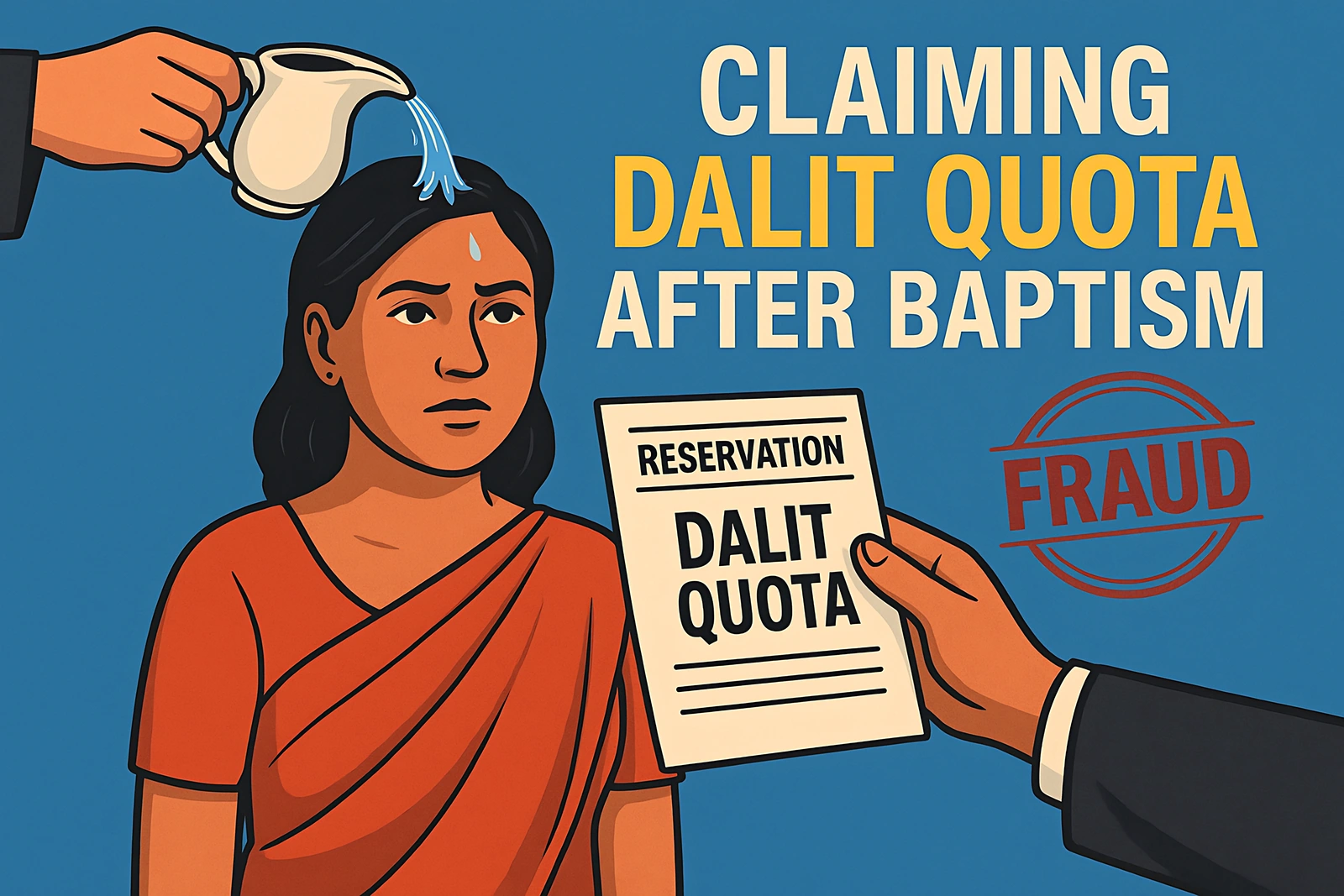
Hindu Claim after Baptism to Grab Dalit Quota is Fraud on Constitution: Supreme Court
Read Rashtra Jyoti's account of a Supreme Court ruling on a Christian applicant's claim to Scheduled Caste status for public employment.

Written by
- Published
- Updated
- Reading time
- 5 min
In this article 4 sections
The Supreme Court of India rejected the plea by a woman who claimed she was eligible for Scheduled Caste status to avail benefits in public employment, despite being born to Christian parents and practicing their faith from birth.
While the woman, aged 34, claimed that her father was Hindu and her mother, although born in a Christian family had converted to Hinduism after marriage, the Court upheld the findings of investigation by local administration that refuted these claims.
Notably, the name of the petitioner’s father in the plea is ‘Christian son of Mounien’.
The Case
The petitioner, C. Selvarani, a resident of Puducherry born on 22 November 1990, had applied for the post of Upper Division Clerk (UDC) under the Scheduled Caste (SC) quota in 2015.


She presented caste certificates in her and her family members’ names and claimed to belong to the ‘Valluvan’ caste – one of the communities recognised as Scheduled Castes in the Union Territory of Puducherry under the Constitution (Pondicherry) Scheduled Castes Order, 1964.
Her application triggered a verification process, where the authorities discovered discrepancies between her claims and the facts on record. An investigation was conducted by the Village Administrative Officer (VAO) and endorsed by the Revenue Inspector.
It revealed a trail of documents establishing that her family professed Christianity – and had been doing so for more than three decades.
The Findings That Brought Her Claim Down
The local investigation unearthed critical documentary evidence:
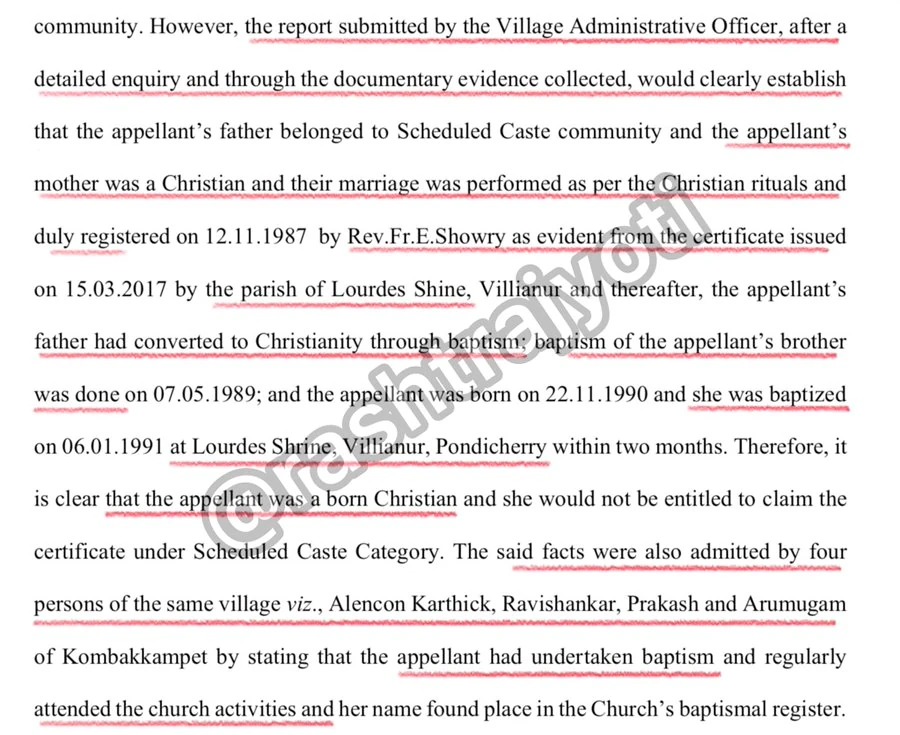
- Church Baptism Records: Selvarani was baptized at the Lourdes Shrine Church in Villianur, Puducherry, on 6 January 1991 when she was 1.5 months old. Her elder brother had been baptized earlier, in 1989.
- Church Marriage Certificate: Her parents’ marriage had been registered in the same church in 1987. The record was retrieved and certified by the parish priest.
- Community Testimonies: At least four villagers – Alencon Karthick, Ravishankar, Prakash and Arumugam – stated on record that the appellant had undertaken baptism and regularly attended the church activities and her name found place in the Church’s baptismal register.
- No Evidence of Reconversion: Neither Selvarani nor her parents had produced any record of formal reconversion to Hinduism. There was no public declaration, no Arya Samaj ceremony, no ritual, and no acceptance from any caste community body.
- Contradictions in Statement: While Selvarani claimed that her mother had converted to Hinduism after marriage, the testimonies from locals indicated otherwise – that her mother remained a practicing Christian and, on the contrary, her father had converted to Christianity before marrying her.
Legal Battle
After her application for caste certificate was rejected by the Tahsildar and subsequent appeals to higher administrative authorities failed, Selvarani approached the Madras High Court. The High Court too rejected her petition in 2023, stating that her claim lacked merit.
She then approached the Supreme Court.
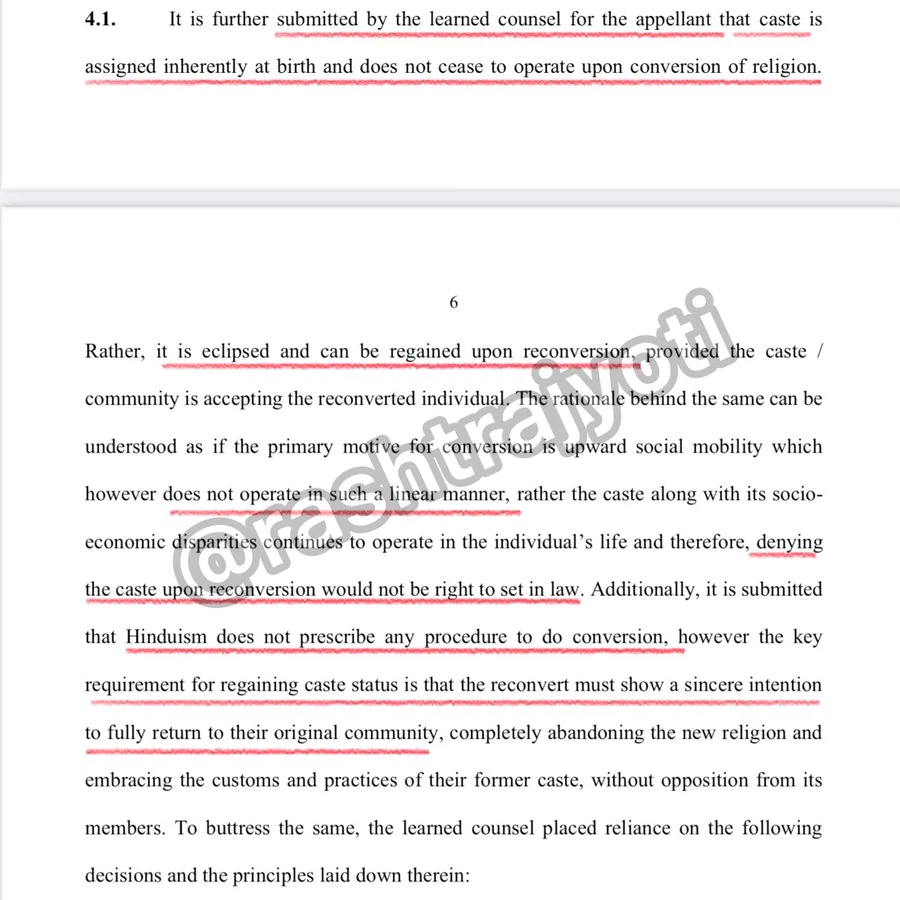
Before the apex court, her lawyers argued that her forefathers belonged to the Valluvan caste, and that caste identity persists even after conversion to Christianity. They cited precedents that allow reconversion to revive caste identity, provided there is community acceptance and proof of sincere return to the original faith.
The Court, however, found no merit in the arguments.
The Supreme Court’s Ruling
The court, observing that as per Para 3 of the Constitution (Scheduled Castes) Order, 1950, the Scheduled Caste certificate can be issued only to a person who is professing either Hinduism, Sikhism or Buddhism, noted:
“…the appellant was a born Christian and could not be associated with any caste. In any case, upon conversion to Christianity, one loses her caste and cannot be identified by it.”
“…the evidence presented clearly demonstrates that the appellant professes Christianity and actively practices the faith by attending church regularly. Despite the same, she claims to be a Hindu and seeks for Scheduled Caste community certificate for the purpose of employment. Such a dual claim made by her is untenable and she cannot continue to identify herself as a Hindu after baptism.”
“Even assuming that the appellant’s mother had converted to Hinduism after marriage, she ought not to have baptized her children in the church and hence, the statement of the appellant is untrustworthy.”
“…the conferment of Scheduled caste communal status to the appellant, who is a Christian by religion, but claims to be still embracing Hinduism only for the purpose of availing reservation in employment, would go against the very object of reservation and would amount to fraud on the Constitution.”
The Court reiterated that caste does not carry over once a person converts to Christianity, as the religion itself does not recognize caste.
Verdict Summary:
- Petitioner: C. Selvarani
- Claim: Scheduled Caste status (Valluvan caste) as Hindu
- Evidence found: Baptism soon after birth, Church marriage of her parents, continued Christian practices
- Court’s view: Attempt to claim Hindu SC identity while practicing Christianity is fraud
- Outcome: Appeal dismissed, earlier caste certificates to be reviewed and canceled
- Date of verdict: November 26, 2024
Below are some excerpt from the verdict:
Written by